
Moxibustion is a heat-based therapy commonly used alongside acupuncture as a complement to conventional medical care. In Traditional Chinese Medicine (TCM), moxibustion is used to warm specific points on the body and promote the flow of qi. From a biomedical perspective, researchers have investigated its effects as a form of localized thermal stimulation that may influence circulation and downstream pain signaling.
Research is promising for several target conditions, but evidence varies in quality. Moxibustion is best considered a complementary therapy rather than a direct substitute for medical treatment.
Treatment Process
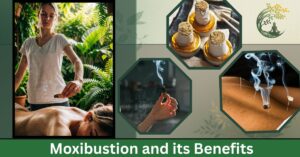
Moxibustion traditionally uses dried mugwort (Artemisia), which is ground into sticks or cones called moxa and ignited to produce heat. In indirect moxibustion, moxa is burned and held above the skin to warm particular areas. The practitioner may also place moxa over acupuncture needles or inside a “moxa box” to warm a larger area.
Direct moxibustion involves placing moxa directly on the skin and carries a greater risk of burns and scarring, thus is less commonly practiced in the United States. Smokeless and infrared alternatives are also available to provide controlled heat while reducing exposure to smoke.
What to Expect During a Moxibustion Session
A moxibustion treatment usually starts with a consultation. During this time, the practitioner will ask questions about your symptoms, medical history, current medications and what you hope to achieve with treatment. They will then decide if moxibustion is right for you and which points/sites on the body should receive heat.
Indirect moxibustion is where the burning moxa is not placed directly on the skin. Instead, it is held a few inches away to produce a warming effect. The practitioner applies the moxibustion and carefully watches the skin temperature and your comfort level. Sometimes moxibustion is used alone. Other times we will use it as part of a more comprehensive treatment strategy that includes acupuncture in San Diego CA.
Treatment duration will vary depending on why you are seeking care, the technique being used, and how you respond to treatment. If at any time the heat starts to feel uncomfortable or painful, let your practitioner know.
Moxibustion vs. Acupuncture: What Is the Difference?
It is important to note that although moxibustion falls under the umbrella of Traditional Chinese Medicine like acupuncture does, the two forms of stimulation are different. Traditional acupuncture usually stimulates with very thin needles placed at specific points on the body, while moxibustion releases heat onto specific areas of the body or acupuncture points.
Acupuncture and moxibustion can also work together. An acupuncturist may choose to apply moxibustion near the acupuncture point they are using or place moxa on top of an acupuncture needle. Some patients seek acupuncture as a method of pain relief. If a patient is interested in trying acupuncture, moxibustion can also be used as a complementary method if it makes sense clinically.
What Does the Research Show?
Breech Presentation
Moxibustion has been studied as a complementary intervention for breech presentation during pregnancy. A 2023 Cochrane review of seven studies involving more than 1,000 women found moderate-quality evidence that moxibustion combined with usual care may reduce non-cephalic presentation at birth, which could aid the birthing process. It did not significantly reduce the rate of cesarean delivery.
Note: Patients should discuss with their primary and obstetric healthcare provider before considering moxibustion treatment during pregnancy.
Knee Osteoarthritis and Pain
A recent systematic review of 39 randomized control trials (RCTs) involving more than 3,200 participants with knee osteoarthritis found improvements in pain and function scores, including WOMAC scores, though trial quality was found moderate-to-low due to inconsistent blinding, probable bias, and small sample sizes.
Moxibustion therefore shows potential as an adjunct for pain management, but stronger clinical trials are still needed to determine how large and reliable the benefit is.
Chronic Kidney Disease
A 2020 systematic review of 23 RCTs involving more than 1,500 patients investigated moxibustion alongside standard CKD treatment. Serum creatinine, blood urea nitrogen, and 24-hour urine protein secretion, as well as quality-of-life scores, improved compared with standard treatment alone for patients with mild to severe CKD.
However, important measures of kidney function, including eGFR, hemoglobin, and creatinine clearance, did not significantly improve. Because the studies also had substantial limitations, such as risk of bias, heterogeneity, and sample size, further research for CKD is needed to confirm the validity of results.
Who May Consider Moxibustion?
Individuals may consider trying moxibustion if they’re looking into complementary therapies for musculoskeletal pain, certain pain disorders, or other issues that have been researched in connection to the treatment. However, the evidence behind moxibustion is inconsistent and depends on the condition.
If moxibustion is right for you will depend on your health history and condition and should be determined by a practitioner. If you’re thinking about trying moxibustion, you should never disregard medical advice in favor of moxibustion. Always seek the advice of a medical professional before beginning any new treatment.
If you’re curious about whether acupuncture, moxibustion, or another complementary treatment is right for you, you can book in for a Free acupuncture Consultation in San Diego to meet with a practitioner. You can talk about any questions or concerns you have regarding your condition, your treatment goals, and your options before beginning treatment.
How Might Moxibustion Work?
The most established physical component of moxibustion is heat. Local heating causes blood vessels near the treatment area to dilate, increasing local blood flow and microcirculation. Heat can also temporarily reduce pain and stiffness and increase tissue flexibility, which may contribute to its use for tight or painful muscles and joints.
Researchers are also studying transient receptor potential cation channel subfamily V member 1 (TRPV1), a heat-sensitive receptor on sensory nerves involved in detecting temperature and visceral pain. A few animal studies have found that moxibustion has the ability to activate TRPV1 receptors, highlighting a possible signal transduction pathway by which moxibustion could affect the nervous system and induce analgesic effects.
Other Areas Being Studied
Moxibustion has also been investigated and used for conditions and symptoms including:
- Musculoskeletal pain
- Menstrual cramps
- Indigestion and GI symptoms
- Diabetic peripheral neuropathy
- Post-stoke rehabilitation
- Chronic fatigue syndrome
- Cancer treatment side effects and symptoms
Evidence varies greatly between these applications, and therefore should not be interpreted as proof that moxibustion effectively treats it.
Risks and Safety
Moxibustion is intended to produce comfortable warmth, but adverse effects can occur. Potential risks include:
- Burns, blistering, skin discoloration, or scarring from direct moxibustion
- Respiratory irritation or coughing from smoke
Extra caution may be appropriate for people with asthma or other lung conditions, impaired skin sensation, pregnancy, or conditions that affect immunity.
When seeking treatment, always consider a properly licensed acupuncturist. National certification can also be verified through the National Certification Commission for Acupuncture and Oriental Medicine (NCCAOM).
Patients should disclose medical conditions, medications, pregnancy, allergies, and respiratory problems before treatment.
The Bottom Line
Moxibustion is a traditional therapy with a plausible modern physiological basis. Clinical research suggests potential benefits, particularly for breech presentation and knee osteoarthritis, while evidence for other conditions remains preliminary. Current research is limited but promising, and further investigation is encouraged to improve study quality, blinding, techniques, and sample sizes.
For those interested in complementary approaches, moxibustion may be an option worth discussing with a qualified practitioner and healthcare provider. It should be used alongside appropriate medical evaluation and treatment, and never as a substitution for basic care.
Frequently Asked Questions About Moxibustion
What is moxibustion used for?
Moxibustion has traditionally been used for a variety of health concerns and has been studied for conditions including pain, knee osteoarthritis, breech presentation, and other symptoms. The quality and strength of scientific evidence differ substantially by condition.
Does moxibustion hurt?
Indirect moxibustion is intended to produce comfortable warmth rather than pain. Patients should immediately tell their practitioner if the treatment feels excessively hot, painful, or uncomfortable.
Is moxibustion the same as acupuncture?
No. Acupuncture primarily uses thin needles to stimulate selected points, while moxibustion uses heat generated from moxa. Practitioners may use the two therapies separately or combine them as part of an individualized treatment approach.
Can moxibustion help with pain?
Some studies have investigated moxibustion for pain-related conditions, particularly knee osteoarthritis. Results suggest possible benefits, but evidence quality varies and further high-quality research is needed. Moxibustion should therefore be viewed as a complementary option rather than a guaranteed treatment for pain.
How long does a moxibustion session take?
Session length can vary depending on the technique, areas being treated, individual needs, and whether moxibustion is combined with acupuncture or another therapy. A practitioner can provide a more specific estimate after evaluating the patient.
Is moxibustion safe during pregnancy?
Moxibustion has been researched in relation to breech presentation, but pregnancy requires additional safety considerations. Pregnant patients should consult their obstetric healthcare provider and a qualified practitioner before receiving moxibustion.
Should I try moxibustion at home?
Because moxibustion involves burning material and significant heat, improper use can cause burns, skin injury, or smoke exposure. Professional assessment and instruction are important, particularly for people with medical conditions, pregnancy, respiratory problems, or impaired skin sensation.
References
Bao, C., Wu, L., Shi, Y., Shi, Z., Jin, X., Shen, J., Li, J., Hu, Z., Chen, J., Zeng, X., Zhang, W., Ma, Z., Weng, Z., Li, J., Liu, H., & Wu, H. (2022). Long-term effect of moxibustion on irritable bowel syndrome with diarrhea: a randomized clinical trial. Therapeutic advances in gastroenterology, 15, 17562848221075131. https://doi.org/10.1177/17562848221075131
Cleveland Clinic. (2022). Moxibustion: What Is It and Does It Work? In Cleveland Clinic. https://health.clevelandclinic.org/moxibustion
Coyle, M. E., Smith, C., & Peat, B. (2023). Cephalic version by moxibustion for breech presentation. The Cochrane database of systematic reviews, 5(5), CD003928. https://doi.org/10.1002/14651858.CD003928.pub4
Jiang, Y., Hu, H., Li, X., Lou, J., Zhang, Y., He, X., Wu, Y., Shao, X., & Fang, J. (2021). Difference in Moxibustion-Induced Microcirculatory Responses between the Heart and Lung Meridians Assessed by Laser Doppler Flowmetry. Evidence-based complementary and alternative medicine: eCAM, 2021, 6644625. https://doi.org/10.1155/2021/6644625
Raypole, C. (2019). What Is Moxibustion? In Healthline. Healthline Media. https://www.healthline.com/health/moxibustion#other-uses
Sater-Wee, D. (2023). Moxibustion in Acupuncture: What You Should Know | AIAM Columbus, OH. (2019). In American Institute of Alternative Medicine. https://www.aiam.edu/acupuncture/moxibustion/
Yuan, T., Xiong, J., Wang, X., Yang, J., Jiang, Y., Zhou, X., Liao, K., & Xu, L. (2019). The Effectiveness and Safety of Moxibustion for Treating Knee Osteoarthritis: A PRISMA Compliant Systematic Review and Meta-Analysis of Randomized Controlled Trials. Pain research & management, 2019, 2653792. https://doi.org/10.1155/2019/2653792
Zhou, X., Wu, Q., Wang, Y., Ren, Q., Zhu, W., Yao, Z., & Chen, J. (2020). Moxibustion as an Adjuvant Therapy for Chronic Kidney Disease: A Systematic Review and Meta-Analysis of 23 Randomized Controlled Trials. Evidence-based complementary and alternative medicine: eCAM, 2020, 6128673. https://doi.org/10.1155/2020/6128673